The crash happened Monday
evening, a night when Hong Kong's busy waters were even more crowded
than usual, as the city celebrated China's National Day.
 One of the two vessels,
owned by The Hong Kong Electric Company, was carrying company employees
and their families to watch the scheduled fireworks display when it was
struck by a passenger ferry traveling from Hong Kong Island to Lamma
Island.
One of the two vessels,
owned by The Hong Kong Electric Company, was carrying company employees
and their families to watch the scheduled fireworks display when it was
struck by a passenger ferry traveling from Hong Kong Island to Lamma
Island.
Government officials said
the collision occurred off Lamma's coast around 8:20 p.m., plunging
more than 100 people into the water.
"I thought we'd hit a
rock or a lighthouse," said Chris Head, a school teacher who was on the
passenger ferry that crashed into the Hong Kong Electric vessel. He said
the ferry went from what felt like full speed to "an abrupt halt."
Head said the force of the impact threw him out of his seat at the back of the ferry, which was not very full of people.
As the damaged ferry
began to move toward the pier in the small town of Yung Shue Wan on
Lamma, Head said he could see the other boat had started to sink into
the water vertically, like the Titanic.
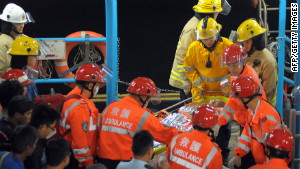 Boats crash, dozens dead in Hong Kong
"It was very dark," he said. "There were very few lights on board."
According to the Hong
Kong Fire Services Department (FSD), which led the rescue, the vessel
began to sink quickly after the impact. It said low visibility and many
obstacles on board made work difficult for rescuers.
The FSD said its rescue boats, including a diving support vessel, managed to pull 123 people from the water.
Twenty-eight people were
declared dead at the scene, and eight others were certified dead upon
arrival at the hospital, according to a statement early Tuesday from the
Hong Kong government.
The death toll would
appear to make the crash Hong Kong's most lethal maritime accident since
1971, when 88 people died after the ferry Fat Shan capsized between
Hong Kong and Macau amid a typhoon.
In 2008, 18 Ukrainian sailors died in 2008 after their boat hit a Chinese cargo ship and sank.
"After 10 minutes out a
boat crashed into ours from the side at very high speed," one male
survivor from the accident Monday told the South China Morning Post, a
local newspaper. "The rear of the ferry started to sink. I suddenly
found myself deep under the sea. I swam hard and tried to grab a life
buoy. I don't know where my two kids are."
Residents on Lamma, a
lightly populated island to the southwest of Hong Kong Island, reported
being woken up in the middle of the night by the massive rescue
operation going on offshore.
On Tuesday, the front of
the stricken vessel was still sticking out of the water, tethered to a
barge equipped with a crane just a few hundred meters from the coast of
Lamma. Emergency services boats surrounded the scene, and divers were
conducting a search.
The authorities have not
ruled out the possibility that some people may still be inside the
partially submerged vessel or missing at sea.
Hong Kong Chief
Executive C.Y. Leung held a meeting with senior government officials to
discuss rescue and relief work, as well as an investigation of the
collision, his office said Tuesday.
Despite a hole torn in
its bow, the passenger ferry was able to dock safely after the crash.
Government officials have not yet confirmed if passengers aboard that
vessel were injured, but Head said nobody around him appeared to have
been hurt.
The narrow sea lanes
leading into Hong Kong's main deepwater harbor are some of the busiest
in Asia, with giant commercial freighters, ocean liners, passenger
ferries and private boats of all sizes sharing the same waters.
Hong Kong is home to
more than 200 outlying Islands, including Lamma, which lies to the
southwest of Hong Kong Island -- the city's financial center. Hong Kong
Island is located to the south of Victoria harbor, with Kowloon forming
its northern shores. To the north of Kowloon lie the New Territories,
which stretch all the way to mainland China.


No comments:
Post a Comment